
USE CASE · DIGITAL TRANSFORMATION
Bringing order to a large organization’s digital ecosystem
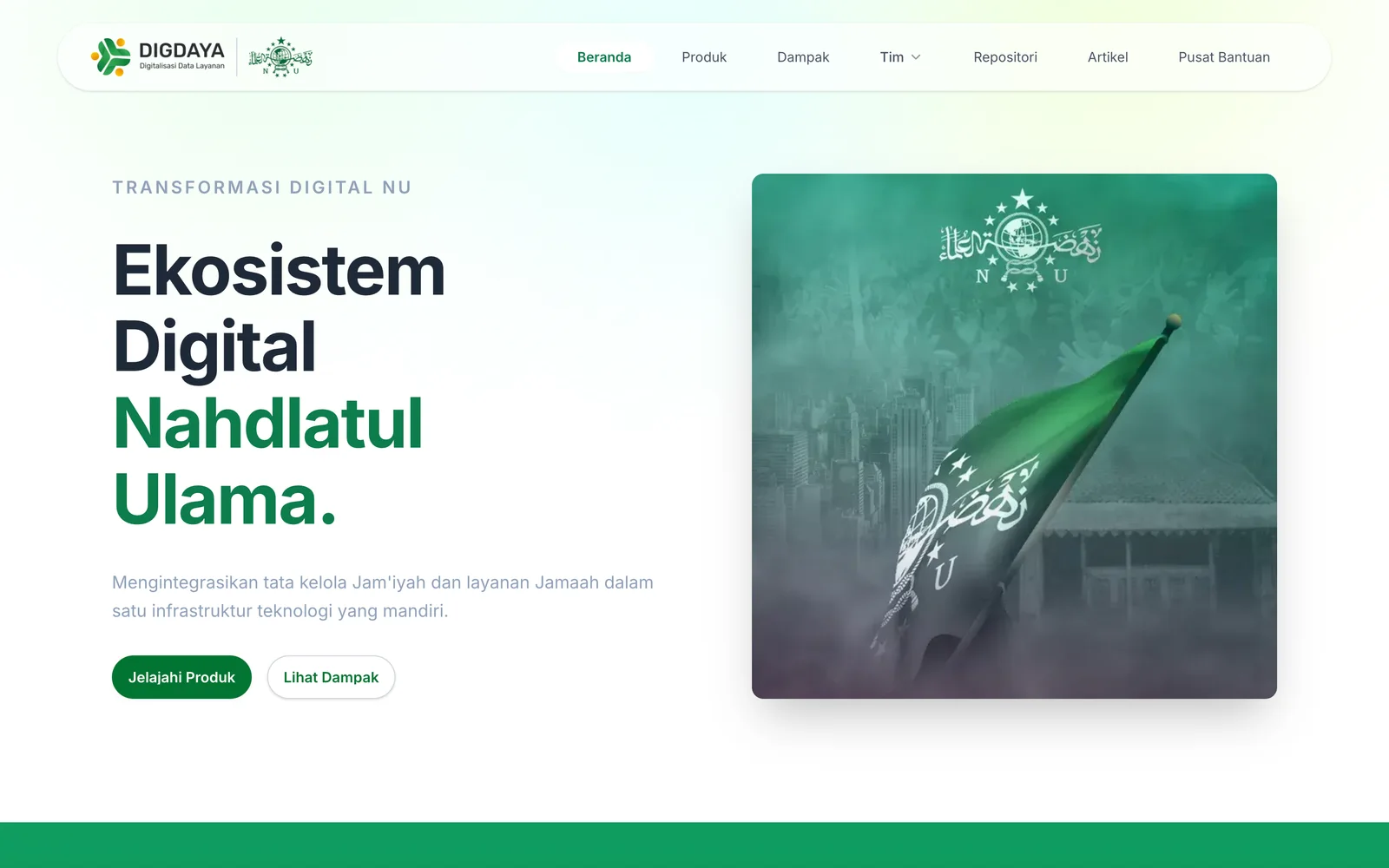
Digdaya NU brings letters, boards, cadres, pesantren, mosques, and an AI assistant into one ecosystem. The Raylab founder worked as a consultant in the role of Head of Digital PMO at PBNU.
Digdaya is the parent ecosystem. Digdaya AI-NU is one part of it, not a separate project; both are presented as one experience.
The Raylab founder worked as a consultant in the role of Head of Digital PMO at PBNU, not as a structural official of PBNU. Digdaya is not a Raylab project. The outcomes above are program outcomes involving many parties.
- Institution or context
- PBNU (Nahdlatul Ulama)
- Founder’s role
- Head of Digital PMO, PBNU (consultant)
- Assignment context
- A professional assignment at PBNU (2023–2026; roadmap since 2022), before Raylab was founded.
Period: 2023–2026 (roadmap since 2022)
Contents
Context and challenge
Administration across thousands of NU boards ran manually. Official letters took 7–10 days, while board and cadre data were scattered across many places without a single source of truth.
At this scale, a digital system also had to follow the organization’s own rules and data-protection requirements, not merely function technically.
Approach and the founder’s contribution
Roadmap and governance first
The NU Digital Transformation Roadmap was translated into a phased product portfolio. The roadmap and governance framework were developed with the boards, referencing the Digdaya organizational regulation (40 articles), internal rules, and Indonesia’s Personal Data Protection Law.
An integrated ecosystem
Single sign-on connects the services, while board data acts as a master API consumed by sector systems. Letters, boards, cadres, pesantren, and mosques share the same data and flows.
AI inside real work
Digdaya AI-NU helps draft letters and study organizational regulations. AI sits inside the work board members already do, rather than as a separate feature, and is part of the parent Digdaya ecosystem.
Adoption across levels
Delivery was accompanied through national, provincial, district, and international branches. A national administrators’ forum supported adoption; the founder’s role focused on direction, governance, and delivery oversight.
Founder’s contribution
Oversaw the roadmap, governance, and delivery of the ecosystem across modules; aligned board needs, product priorities, and adoption across levels of the organization. This was a consultant role, not a structural office at PBNU.
Program outcomes
55,000+
outgoing letters processed
154,000+
verified cadres
10,000+
mosques registered
2,600+
pesantren registered
- Letters are processed in hours instead of 7–10 days.
- Used by 38 provincial boards, 520+ district boards, and 20+ international branches; piloting in about 600 sub-district boards and reaching village level.
- 55,000+ outgoing and 69,000+ incoming letters processed, 3,100+ decrees issued, 154,000+ verified cadres, 10,000+ mosques, and 2,600+ pesantren with 35,000+ students registered.
- Digdaya Correspondence was a Top 20 finalist in the WSIS Prize 2025 (E-Government) out of 973 global submissions and is listed in the ITU/UN WSIS Stocktaking Database.
Figures come from program materials. The snapshot date is not recorded, so they should not be read as real-time data.
Work samples
What other institutions can take from it
- Governance and data rules should be agreed before technology is built.
- One integrated ecosystem is more useful than a collection of separate applications.
- The most honest measure of success is use, not the completion of construction.